


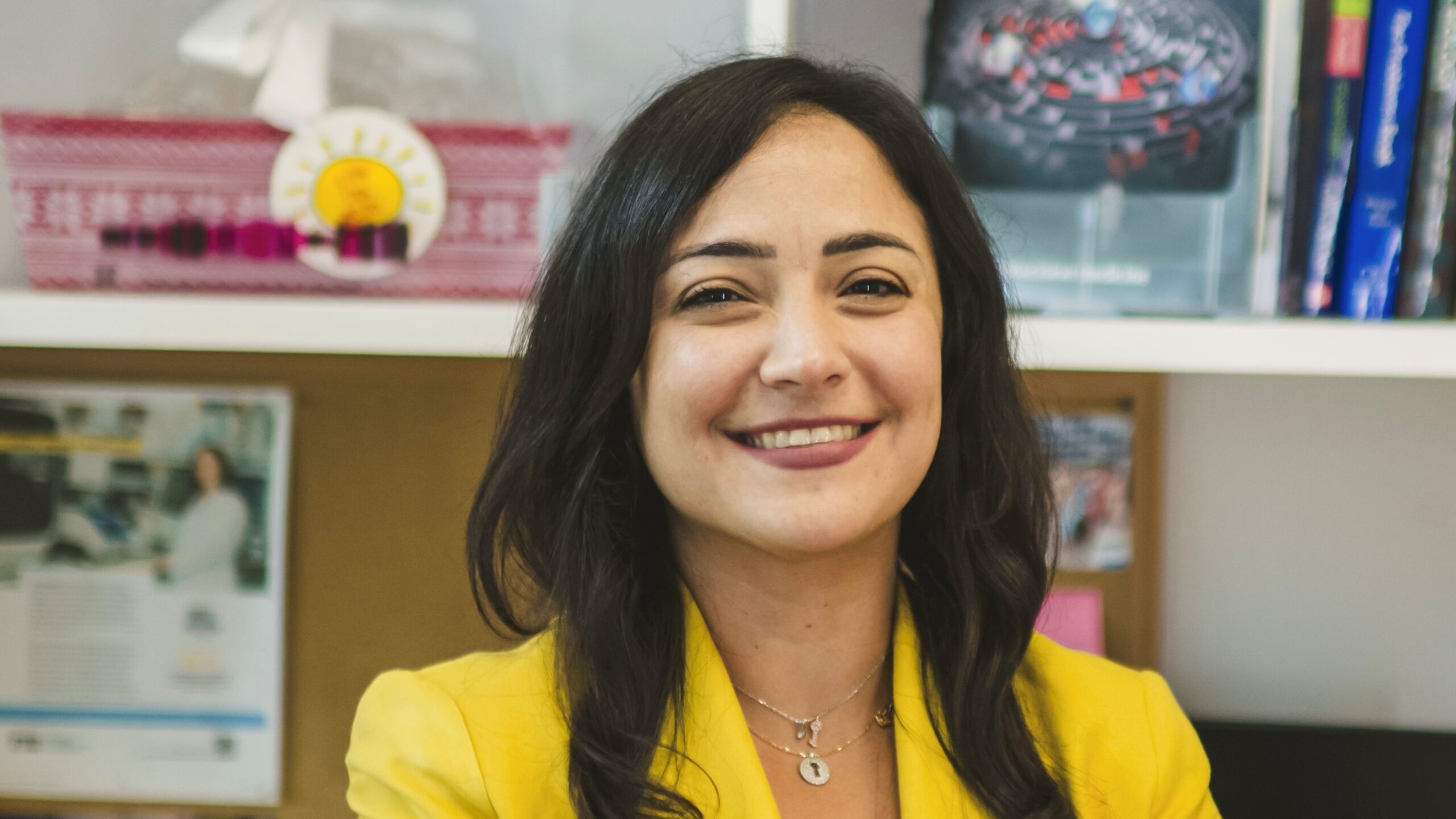
Dr. Diana Azzam is a translational cancer scientist, newly appointed Department Chair at Florida International University, Scientific Director of the Center for Advancing Personalized Cancer Therapeutics, and Co-Founder of First Ascent Biomedical.
BIOLINK: You earned a master’s in biochemistry at the American University of Beirut before completing your PhD at the University of Miami Miller School of Medicine, and moving into cancer stem cell and therapy-resistance research. What drew you to the hardest cases?
DA: Thankfully, I don’t have a personal cancer story that drew me to this. But when I started my PhD, I wanted to join a lab focused on cancer, because the question I always had was: why does cancer come back? Why do patients relapse? I found the lab of Dr. Joyce Slingerland, who was director of the Breast Cancer Institute at the University of Miami at the time. She gave me a bunch of papers on a whole new field–cancer stem cells–and told me to read about them and let her know if it was something I wanted to work on.
These are small subpopulations within tumors that are resistant to therapy and responsible for relapse and metastasis. They have properties completely different from the bulk tumor. For example, they may express certain transporters on their membrane that efflux chemotherapy drugs. During my PhD, I isolated and characterized a small subset of cells within triple-negative breast cancer tumors using specific biomarkers. When I took equal numbers of the tumor bulk and the enriched cancer stem cells and put them in mice, the ones enriched for cancer stem cells were the only ones that metastasized. The tumor bulk formed tumors, but didn’t spread. So clearly, the cancer stem cells were the ones responsible for metastasis. That work made me realize: if these are the cells driving resistance and relapse, we need to focus there.
BIOLINK: How did your research lead to the creation of First Ascent Biomedical? How does the technology work, from the moment a patient’s tumor sample arrives in your lab to the treatment recommendation that reaches their oncologist? Does insurance cover the test?
DA: During my postdoc, I was fascinated by the high-throughput drug screening technologies we have in pharma: the ability to test hundreds or thousands of compounds against cancer cells very fast. That’s used to find new drugs. But if you look at whether that technology is available in the clinic, you’ll be surprised. It’s not. That was the turning point for me: we have these incredible technologies in pharma to discover novel drugs, but we don’t use them to find drugs that would work against a patient’s own cancer cells.
As the research progressed, it became clear that if we wanted to make this available to more patients, we needed to take it out of an academic lab; that’s why I co-founded First Ascent. My co-founders are Dr. Noah Berlow, who developed the machine-learning approach that integrates all the data, and Jim Foote, whose son Trey passed away from osteosarcoma, so it became a personal motivation for building something that could help other families. The platform I developed is based on my PhD work. I learned how to enrich for cancer stem cells, the most therapy-resistant cells within a tumor, in enough numbers to test hundreds of drugs. That’s a licensed IP from my lab to First Ascent. So here’s how it works: a [tumor] sample is sent live to our lab, the same way you’d send a [blood] sample to a lab like Quest. We derive a short-term culture that contains the tumor cells along with the microenvironment. We’ve shown in our Nature Medicine paper that these cultures retain a lot of characteristics similar to the tumor they’re derived from.
From there, we run three things together: genomics, functional drug testing against our library of about 150 FDA-approved drugs, including standard chemotherapies, cancer drugs not approved for that specific cancer type, and non-cancer medications like allergy or cholesterol drugs. AI ranks which drugs are worth testing based on what’s published and on clinical trial data, and helps interpret the combined results. We send a report back to the physician in 10 days.
On insurance, it’s not covered yet. We’re working on the regulatory pathway, including FDA breakthrough device designation, to get it covered. In the meantime, we have funding from the state of Florida that covers testing for 200 Florida cancer patients, plus a few other grants subsidizing the cost so patients don’t have to pay.
BIOLINK: One successful case is Logan’s, a young patient with relapsed leukemia. Can you tell us his story?
DA: Logan’s story is very special to me because it really captures why we do this work. He was only three years old when he was diagnosed with acute myeloid leukemia. He’d gone through several rounds of chemotherapy and received a bone marrow transplant from his baby sister, and went into remission. But after a year, his leukemia came back, and that’s when he entered our functional precision medicine study.
We received a sample of his cancer and tested hundreds of drugs against his cells. Within a week, we identified which targeted drug worked best for him, and just as important, we were able to get rid of a drug that wasn’t doing much and was very toxic to his heart. We also found something surprising: his cells doubled in number in response to steroids, which are routinely given before transplant to suppress the immune system. All of that information went to his oncologist. She removed the steroids from his regimen, dropped a chemotherapy drug that turned out not to be needed since two drugs were as effective as three, and gave him the targeted drug we’d identified, midostaurin, since he had a FLT3 mutation. Using all of that, he achieved undetectable minimal residual disease in 33 days, got a second bone marrow transplant, and today–more than four years later–he’s cancer-free, in school, and playing soccer.
Logan is only one story. Usually our trial patients are de-identified, so I only found out he was one of “mine” by chance, when I met his mom at a conference. We have kids in our ongoing study now getting out of hospice because of recommendations from our platform, and I can’t wait to share those stories once we publish.
BIOLINK: What’s your next milestone at First Ascent Biomedical?
DA: I’m working on submitting the manuscript for our ongoing pediatric study. That study has grown from one hospital in Miami, Nicklaus Children’s, to 24 children’s hospitals across the nation, and we’ve now enrolled over 140 patients across our pediatric and adult trials combined.
On the infrastructure side, our lab in Miami has capacity for 2,500 patient samples a year, and we have another lab ready to open in Erie, Pennsylvania, with capacity for 15,000. And clinically, my goal is to bring this technology a little more upfront rather than reserving it as a last resort. We’re starting clinical trials in cancers that don’t have a strong standard of care, like newly diagnosed metastatic pediatric and adult sarcomas.